
Doc Man, you are correct about Option Explicit, but I still find it a bit long in tooth.
For example, in VB.NET, there is a Option Strict, which basically forbade any implicit datatype, so 1/24 (as integer) + date () (as double) will be rejected by the compiler with an error, and require you to explicitly typecast as cdbl(1/24) + date().
You also probably already know that Ada is among the most anal-retentive language out there regarding typecasting, which is very good thing for mission critical applications. I certainly wouldn't want to toggle a nuclear missile launch because there was an implicit typecast that I didn't know about!!

Implicit typecasting are not inherently bad in themselves- they were provided to make our job easier and remove the boring, repetitive tasks of checking variables' type at write time when compiler could very well handle it. I would be just equally happy if the compiler would at least tell me that it'll have to do a implicit typecast on a line after I pressed return... perhaps as a auto-magic comment to right of my recently inserted line of code so I know a bit about the background.
This is especially more true when we consider that Access is more likely to be developed by someone who isn't a full-time programmers with formal education in designing and deploying software solution.
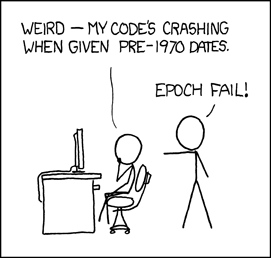
Regarding date/time type, I think this is a good point- it would be very bad idea to get raw binary representation and add it with another binary representation because that would mean we're assuming the epoch is same. I think this illustrate the problem very well:
For example, in VB.NET, there is a Option Strict, which basically forbade any implicit datatype, so 1/24 (as integer) + date () (as double) will be rejected by the compiler with an error, and require you to explicitly typecast as cdbl(1/24) + date().
You also probably already know that Ada is among the most anal-retentive language out there regarding typecasting, which is very good thing for mission critical applications. I certainly wouldn't want to toggle a nuclear missile launch because there was an implicit typecast that I didn't know about!!
Implicit typecasting are not inherently bad in themselves- they were provided to make our job easier and remove the boring, repetitive tasks of checking variables' type at write time when compiler could very well handle it. I would be just equally happy if the compiler would at least tell me that it'll have to do a implicit typecast on a line after I pressed return... perhaps as a auto-magic comment to right of my recently inserted line of code so I know a bit about the background.
This is especially more true when we consider that Access is more likely to be developed by someone who isn't a full-time programmers with formal education in designing and deploying software solution.
Regarding date/time type, I think this is a good point- it would be very bad idea to get raw binary representation and add it with another binary representation because that would mean we're assuming the epoch is same. I think this illustrate the problem very well:


