jysharp2003
New member
- Local time
- Today, 09:17
- Joined
- Feb 19, 2018
- Messages
- 9
Hi,
I have a customer application that needs to detect and query return records that do not have the largest value in field. Example below:
field value is 1.1.1.1 where in another table there is a value of 1.1.1.1.1 that should be in it's place.
I think that maybe a query that detects period count greater than 3 (in this example) and having the same numeric of one's (1.1.1.1) that would return in query would be our need.
Another example to solidify the need is:
field value is 1.13.1.6 where in another table there is a value of 1.13.1.6.8 that should be in its place.
Logic should be if value contains 3 periods which equates to 4 segments then the query should detect and alert on "same" numeric 4 segment values and return which is the MAX 5th (or higher).
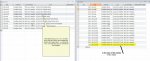
Example in screenshot shows a 5th segment available value that should be in the U Temp record.
1.13.1.13 inside story should be 1.13.1.13.8 inside story from tv which is the MAX. I have uploaded a DB to share the sample tables.
I can't say how much I appreciate your time in getting the query right and accurate for detecting availables.
I have a customer application that needs to detect and query return records that do not have the largest value in field. Example below:
field value is 1.1.1.1 where in another table there is a value of 1.1.1.1.1 that should be in it's place.
I think that maybe a query that detects period count greater than 3 (in this example) and having the same numeric of one's (1.1.1.1) that would return in query would be our need.
Another example to solidify the need is:
field value is 1.13.1.6 where in another table there is a value of 1.13.1.6.8 that should be in its place.
Logic should be if value contains 3 periods which equates to 4 segments then the query should detect and alert on "same" numeric 4 segment values and return which is the MAX 5th (or higher).
Example in screenshot shows a 5th segment available value that should be in the U Temp record.
1.13.1.13 inside story should be 1.13.1.13.8 inside story from tv which is the MAX. I have uploaded a DB to share the sample tables.
I can't say how much I appreciate your time in getting the query right and accurate for detecting availables.