I identify as vaccinated

Or even how many people have died of Covid. I don't know anyone, so I suspect that the chances of me knowing someone at who has died from the vaccine is going to be very very remote.
I think they said something on the telly about a month ago that no one had died of Covid having been vaccinated, with a sample size of about 6,000 people. My accuracy and detail are vague on this, but I believe that was the gist of it. Of course, we could all fall dead in a year after taking the vaccine, but I think that scenario is verging on conspiracy theory territory.

Edit: And I think at the time I crunched the numbers and it reduced my risk of catching Covid a hundredfold. But again, I'm sketchy on the accuracy.
 
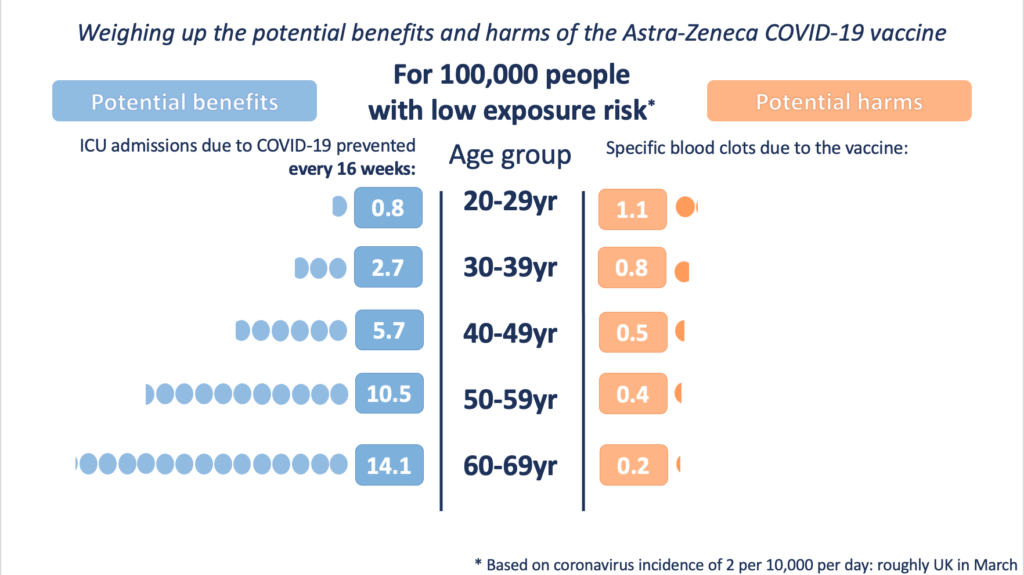
Here is a chart that covers some risk data:

image3-1024x575.png


So the argument you have is that if an example exists of poor outcomes from a medicine that happen years later, you cannot make good judgements on risk of any medicine until many years later. Now let us apply that to the flu vaccine. How many lives are save as a result of the flu vaccine, where you could apply the same argument? Or any pioneering drug?
I think you are having a very hard time defending your assertion that 3 months of data on a major new vaccine ought to be enough to make hesitation unreasonable, especially when presented with the fact that it is very common for negative impacts of pharmaceuticals not to be discovered for a long time = Years. If you like, we can agree to disagree. :)

The reality is: 3-month data is a different thing than 20-year data. You cannot equivocate 3-month results with 20-year results; they are two different things.

Your reliance on the numbers you quote is a major oversimplification of the situation.

Ask a scientist whether they can properly identify the 20-year impact of a medication within the first 3 months.
 
I had my second jab about 6 weeks ago.
I believe vaccination should be mandatory.
 
  • Like
Reactions: Jon
I think you are having a very hard time defending your assertion that 3 months of data on a major new vaccine ought to be enough to make hesitation unreasonable, especially when presented with the fact that it is very common for negative impacts of pharmaceuticals not to be discovered for a long time = Years.
Let us take the scenario that no one takes the vaccine because the 20 year risk profile may be different to say a 3 year profile. What happens? Tens of millions dead. Look what happened with the Spanish Flu way back, where it is estimated 500 million people, or one-third of the world's population became infected. Vaccines are the way out of a pandemic and all governments are advising us to take the vaccine. Why? Because they have teams of virologists and medical experts working on the risk vs rewards.

Waiting for 20 years of data before making a decision while 3.5 million people have already died of the virus is a recipe for disaster.

I think you will have a very hard time defending that position.
 
Last edited:
For those who suffer the fear, here is some information from the CDC:


Everything has risk, like driving your car to work; going for drink in the evening and therefore increasing your risk of a deadly brawl; getting food poisoning in a restaurant. No one has perfect information, but we still take that risk. Vaccines are proven treatments for reducing death on a mass scale. If there is dispute on this truth, can someone show me the evidence where the numbers saved from taking a vaccine was less than the numbers saved?
 
Let us take the scenario that no one takes the vaccine because the 20 year risk profile may be different to say a 3 year profile. What happens? Millions dead. Vaccines are the way out of a pandemic and all governments are advising us to take the vaccine. Why? Because they have teams of virologists and medical experts working on the risk vs rewards.

Waiting for 20 years of data before making a decision while 3.5 million people have already died of the virus is a recipe for disaster.

I think you will have a very hard time defending that position.
First, regarding "they have teams of virologists and medical experts working on the risk vs. rewards". Actually, many medical professionals have expressed concern about the blanket way the vaccine is universally being given. For example, many would have preferred to wait until more studies were done about antibody immunity via having already had COVID. A study just came out yesterday that reinforced the idea that significant immunity is present, and lingers, after having had the virus. Thus, this becomes just one aspect that should have been handled differently - antibody test prior to vaccine, to avoid over vaccinating people who had no need to be.

Second, keep in mind that 650,000 people die of flu-linked respiratory conditions each year.

Third, and you may have missed this in one of my earlier posts so I will essentially repeat it here: I never suggested that nobody should get the vaccine, which is the false choice you are presenting me with - and mistakenly attributing to me. On the contrary, I suggested that since reasonable minds differ, enough people (who want to be vaccinated) are, indeed, getting vaccinated, to make the difference that we need to end the crisis. Because this compromise is sufficient to give the world the improvement it needs, those who choose not to vaccinate ought to be respected - and, like post 21 so eloquently and succinctly shows - people have very good reason to consider 3-month data far from being conclusive or sufficient.

Lastly, also recall that I noted I agree with much of what you originally said. Where I disagree is one major justification that you used for your position: That the successful implementation of something at the 3-month mark, on a subject that typically requires years to be proven safe, is all that is needed to evaluate the risk. That simply isn't true, as we know from history on pharmaceuticals. I notice that now that you have been presented with more realistic numbers regarding when adverse effects of things are discovered, you have switched from numbers to generic statements, which is understandable because the numbers aren't very persuasive, yet.

And actually, I haven't even gotten started yet on the less-data driven, less-quantifiable reasons not to trust the vaccine.

Here are a few - food for thought. I think I'll bow out after this, I've made my point. Faced with all this, anyone can understand why any individual's risk calculation is taking into account far more than the ones you've put forth:

  • Have NEVER had the experience of bringing a vaccine to market prior to COVID: (Moderna, Johnson & Johnson).
  • Are serial, criminal felons - sanctioned in a criminal capacity for doing a bad job on the health aspects of prior products: (Pfizer, Astra Zeneca, and Johnson & Johnson)
  • Simultaneously to the above, have been granted immunity from legal liability, for vaccines. No liability = no trust.
  • There have been numerous attempts to make vaccines for the coronavirus in the past. They have ended in sickness, death, and utter failure. You can read more about this here.
  • The Adverse Events Reporting system was not working, during significant portions of time, post-implementation
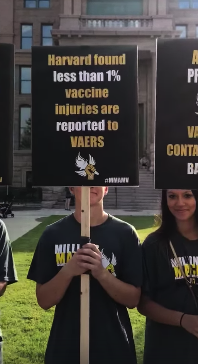
  • According to a study done by Harvard (at the commission of our own Government), less than 1% of all adverse reactions to vaccines are actually submitted to the National Vaccine Adverse Events Reports System (VAERS). Do you feel differently now about your numbers on Adverse Effects?
That's a few to get you started, but I have to get back to work. Thanks for the good discussion.
 
What is bodering me about all that decisions about the vaccine is the clinical studies. I think we need more time to be sure about all.

Length of clinical trials by number of years: Ranking the top ten​


10. Tamoxifen for Breast Cancer

10. Tamoxifen for Breast Cancer – January 1994 till date​


9. All-trans Retinoic Acid for Acute promyelocytic leukaemia

9. All-trans Retinoic Acid for Acute promyelocytic leukaemia – September 1993 till date​


8. Radiotherapy with or without chemotherapy for Lymphoma

8. Radiotherapy with or without chemotherapy for Lymphoma – September 1993 till date​


7. EPOCH chemotherapy and rituximab for non-Hodgkin’s lymphoma

7. EPOCH chemotherapy and rituximab for non-Hodgkin’s lymphoma – May 1993 till date​


6. Multifactorial intervention for type-2 diabetes

6. Multifactorial intervention for type 2 diabetes – January 1992 till date​


5. Chemotherapy with or without radiotherapy for Hodgkin’s lymphoma

5. Chemotherapy with or without radiotherapy for Hodgkin’s lymphoma – September 1989 till date​


4. Gonadotropin-releasing hormone effect on Kallmann syndrome

4. Gonadotropin-releasing hormone effect on Kallmann syndrome – April 1989 till date​


3. Implanted stimulator for restoring hand functioning in spinal cord injury

3. Implanted stimulator for restoring hand functioning in spinal cord injury – April 1989 till date​


2. GnRH effect on women infertility

2. GnRH effect on women infertility – January 1989 till date​


1. Botulinum Toxin for involuntary movement disorders

1. Botulinum Toxin for involuntary movement disorders – November 1985 till date​

 
The antibody idea before vaccination seems like a good idea in theory. I do think the pragmatic choice is just to get it done, since this is all done in a hurry and with limited resources. But in theory, I like the idea.

I am not sure what point you were making with the 650,000 flu death figure. To contrast with Covid, 3.5 million dead despite huge lockdowns all over the world.

Your third point, I did not mean to give you a false choice. Instead, I am commenting on the individuals assessment of risk and the opportunity cost of not taking the vaccine. If "enough" people get vaccinated, it still means that those who are not vaccinated are at risk personally or of spreading the disease. Persistently not getting vaccinated for something that is here to stay means the accumulation of risk over time becomes significant.

Where I disagree is one major justification that you used for your position
It isn't just my position, but the position of all governments throughout the world and most scientists who specialise in this area.

That the successful implementation of something at the 3-month mark, on a subject that typically requires years to be proven safe, is all that is needed to evaluate the risk. That simply isn't true, as we know from history on pharmaceuticals.
I believe you are disputing the safety assessments of the medical governing bodies and trials throughout the world. They believe you can evaluate the risk effectively within the timeframe they had, relative to the potential rewards.

you have switched from numbers to generic statements, which is understandable because the numbers aren't very persuasive, yet.
I think I understand what you are saying. You are saying that the huge decrease in Covid rates for countries that are going through their vaccination process are not persuasive. You are saying that the huge reduction in infection rates measured so far, as presented in my previous charts, are not persuasive. Unless I misunderstood you.

I have not switched to generics from numbers. In my second to last post, 5 numbers! Just discredit my arguments on their logic, rather than attacking any generic points I make. Or, show how my generic points have no merit.

Have NEVER had the experience of bringing a vaccine to market prior to COVID: (Moderna, Johnson & Johnson).
Yet they have still created vaccines that have saved hundreds of thousands of people from death.

Are serial, criminal felons - sanctioned in a criminal capacity for doing a bad job on the health aspects of prior products: (Pfizer, Astra Zeneca, and Johnson & Johnson)
Then close them down because who wants life saving drugs from a bunch of criminals. Let people die instead.

Simultaneously to the above, have been granted immunity from legal liability, for vaccines. No liability = no trust.
Don't trust these people who have produced vaccines that are proven to save lives.

There have been numerous attempts to make vaccines for the coronavirus in the past. They have ended in sickness, death, and utter failure.
Yet we have vaccines for Covid that is working without significant sickness, death and utter failure. In fact they are saving the planet!

According to a study done by Harvard (at the commission of our own Government), less than 1% of all adverse reactions to vaccines are actually submitted to the National Vaccine Adverse Events Reports System (VAERS). Do you feel differently now about your numbers on Adverse Effects?
Still, the evidence is in the hospitals. Previously overloaded, now well within capacity. The evidence is overwhemling.

That's a few to get you started, but I have to get back to work. Thanks for the good discussion.
You're welcome @Isaac !
 
The antibody idea before vaccination seems like a good idea in theory. I do think the pragmatic choice is just to get it done, since this is all done in a hurry and with limited resources. But in theory, I like the idea.

I am not sure what point you were making with the 650,000 flu death figure. To contrast with Covid, 3.5 million dead despite huge lockdowns all over the world.

Your third point, I did not mean to give you a false choice. Instead, I am commenting on the individuals assessment of risk and the opportunity cost of not taking the vaccine. If "enough" people get vaccinated, it still means that those who are not vaccinated are at risk personally or of spreading the disease. Persistently not getting vaccinated for something that is here to stay means the accumulation of risk over time becomes significant.


It isn't just my position, but the position of all governments throughout the world and most scientists who specialise in this area.


I believe you are disputing the safety assessments of the medical governing bodies and trials throughout the world. They believe you can evaluate the risk effectively within the timeframe they had, relative to the potential rewards.


I think I understand what you are saying. You are saying that the huge decrease in Covid rates for countries that are going through their vaccination process are not persuasive. You are saying that the huge reduction in infection rates measured so far, as presented in my previous charts, are not persuasive. Unless I misunderstood you.

I have not switched to generics from numbers. In my second to last post, 5 numbers! Just discredit my arguments on their logic, rather than attacking any generic points I make. Or, show how my generic points have no merit.


Yet they have still created vaccines that have saved hundreds of thousands of people from death.


Then close them down because who wants life saving drugs from a bunch of criminals. Let people die instead.


Don't trust these people who have produced vaccines that are proven to save lives.


Yet we have vaccines for Covid that is working without significant sickness, death and utter failure. In fact they are saving the planet!


Still, the evidence is in the hospitals. Previously overloaded, now well within capacity. The evidence is overwhemling.


You're welcome @Isaac !

You lean a lot on your trust for governmental bodies - and what their current opinion is.
I hope it works out well, but experience teaches us that years of collecting data is often necessary before we can accurately assess the risk or harm. In fact I seem to remember a country whose government was trusted to perform dangerous research on a virus, whose terrible mistake unleashed a pandemic on the world ...
Personally, the longer I live, and the more I see, the less I trust the government. I understand that not everyone may feel that way. Perhaps it's a British vs. American cultural thing?

Yet they have still created vaccines that have saved hundreds of thousands of people from death.
If everyone's expected life span was exactly an additional three months, then that statement would actually be accurate!
Don't trust these people who have produced vaccines that are proven to save lives.
Or, put another way: Don't trust these people who have produced vaccines that have killed and sickened many, previously.

Don't get me wrong, I can understand why there is a panic to put down this bet and engage in the gamble. But it's a gamble.
Past behavior is the best predictor of future behavior.
Still, the evidence is in the hospitals. Previously overloaded, now well within capacity. The evidence is overwhemling.
I don't see reduced hospitalization of COVID patients as negating the possibility of unreported adverse effects. Especially if we already have a study that proved 99% of adverse effects are un-catalogued. I do agree that reduced hospitalization of COVID patients is a reliable indicator of reduced medical distress from COVID - Yes. But maybe doesn't have much to do with adverse vaccine effects.
 
Last edited:
You lean a lot on your trust for governmental bodies - and what their current opinion is.
Not true. I rely on the vast body of scientific evidence and medical opinion, not just what governments say. For example, the governments were saying masks don't work but I disputed this, despite what they said. This is all verifiable from my Covid comments on this forum before the governments said we should be wearing masks. I also locked down a week before our own government did their lockdown. I look at reported data, what governments say, since they are relying on what the scientists and data modellers say. I look at what is happening to the numbers after vaccinations start. I look at the trends in the data. It is nothing about trusting the government, and everything about analysis of what data I see.

If everyone's expected life span was exactly an additional three months, then that statement would actually be accurate!
Do you apply the same argument to the near eradication of smallpox and polio through use of vaccines, since what happens if 50 years later there is an adverse reaction?

Don't trust these people who have produced vaccines that have killed and sickened many, previously.
So don't trust buying a car from a brand where there has been a manufacturing defect leading to an accident? Then go by horse.

Don't get me wrong, I can understand why there is a panic to put down this bet and engage in the gamble.
It is not a gamble. It is a carefully scrutinised clinical trial process, used throughout medicine. It is the opposite of a gamble. What is a gamble is to say you won't take a vaccine because you do not have data of the 20 year situation, while there is real risk of death now and of infecting others.

I don't see reduced hospitalization of COVID patients as negating the possibility of unreported adverse effects
Adverse effects can include a headache. To say that 99% of adverse effects are un-catalogued suggests to me they were not significant enough to warrant reporting.

Or, this link has a few things to say about whether or not the Harvard study is saying what some purport:

 
Last edited:
Do you apply the same argument to the near eradication of smallpox and polio through use of vaccines, since what happens if 50 years later there is an adverse reaction?
I was only reacting to your claim that vaccines have saved thousands of lives, and pointing out that is only a true statement if everyone's lifespan was 3 months .... then you could extrapolate that.
 
I was only reacting to your claim that vaccines have saved thousands of lives, and pointing out that is only a true statement if everyone's lifespan was 3 months .... then you could extrapolate that.
But they already have saved thousands of lives. It is in the data. Otherwise, how do you account for the drop in deaths?
 
But they already have saved thousands of lives. It is in the data. Otherwise, how do you account for the drop in deaths?
You're missing the point I'm making about the 3 months. I'm suggesting that it can be argued they haven't necessarily "saved a life" unless it is also true that they do not kill that same life, which won't be known until the end of its natural life.

If a drug saves me from dying today, but kills me tomorrow, has it saved my life? Perhaps that's more philosophical than mathematical.

And as for the part about car manufacturer defects vs. buying horses:
Actually, people DO try to avoid buying vehicles from manufacturers, lines or models that have poorer safety defects, hence the existence of Consumer Reports magazine that people look in before buying a car. But the analogy is a stretch: With your car scenario, you're suggesting people would have to avoid ALL cars and buy a horse, which would make modern life impossible. I'm suggesting some people might want to wait longer to get the vaccine, which - given the reality, which is, the pandemic will easily be defeated as long as those who are enthusiastic about getting the vaccine do so - is going to turn out OK.

Remember: We don't need every human being to get the vaccine. The pandemic can be defeated with something far less than that.

Keep in mind: I actually got the vaccine. I just try to understand the position of those who haven't.
 
I didn't miss the point, I knew exactly what you were getting at. You are saying that even if vaccines cut the number of deaths in the millions, because the future is uncertain you cannot be 100% sure that more people will die because of the vaccine and therefore that is reason to not take a vaccine. But once again, we are back to the rational choice argument which I have made from the outset. Avoiding any risk from the vaccine exposes yourself to the risk from what the vaccine protects you from. And that risk is cumulative.

Actually, people DO try to avoid buying vehicles from manufacturers, lines or models that have poorer safety defects,
Well, let me use your own argument against you. Let us say they choose a manufacturer with a low incident rate of defects. You still don't know 20 years from now if that car will have a lethal defect or not. Therefore, using the principle you are arguing with, you would understand someones position who decides not to buy the safest model of car because you cannot be 100% certain in the future. They choose horse, while ignoring the risk of dying from falling from that horse, which is greater than dying from a parts failure on the car.

I'm suggesting some people might want to wait longer to get the vaccine, which - given the reality, which is, the pandemic will easily be defeated as long as those who are enthusiastic about getting the vaccine do so - is going to turn out OK.
So don't get the vaccine yourself to save yourself, while exposing your friends, family, children, relatives, yourself, Mother Teresa and the rest of the human race to a potentially lethal infection.

Keep in mind: I actually got the vaccine. I just try to understand the position of those who haven't.
I understand Isaac. It is good to try to understand others position and I try to do the same. My take on it is that the others perspective is an irrational and selfish one. They expose themselves to greater harm by not taking the vaccine. And since a virus does not operate in a vacuum, it exposes risk to everyone else too.

Think of this as an analogy. Someone is given two revolvers, both of which shoots off random bullets. There is a 1 in 500 chance of Revolver A (no vaccine) going off, potentially killing yourself or someone else. Revolver B (vaccinated) has a 1/1,000,000 chance of going off. Given the choice, which would you want to keep in your pocket?

You could argue that Revolver B might go off more frequently in the future and so you want to hesitate in your choice. But so can Revolver A. The virus mutates, and the strains that infect faster become the dominant strain. Faster infections = even greater risk.

Edit: Please note that I am not your GP. I have no medical training, except 2 hours of resuscitation training. Consult your medical practitioner and solicitor for advice. All examples above are fictitious and are not intended to represent anyone, even Mother Teresa.
 
Last edited:
And since a virus does not operate in a vacuum, it exposes risk to everyone else too.
Flawed logic Jon, and a company song from the get-go. If you truly trust the vaccine (I don't) then how are the vaccinated at risk?
 
Not sure what you mean by company song. I am assuming you think my logic is flawed because of my use of the word "everyone".

A vaccine does not give 100% protection (1st jab 70%, 2nd jab 90% if Astra Zenica). You can still get infected and die, or spread it to others even if vaccinated. It just reduces the risk significantly. It is black and white thinking if you perceive vaccines to be 100% protection. And my arguments are not just about the individual, but the risk of infecting others, and that includes the vaccinated and unvaccinated. There are millions of people still waiting for their 1st or 2nd jabs. And vaccination protection declines over time, which results in increased exposure. What about those in countries that cannot get or afford the jab, like Africa? Do their lives not count too? It is a global problem. The unvaccinated elsewhere will lead to more mutations and further global spread.

I am interested in where you think my logic is flawed...
 
Last edited:

Users who are viewing this thread

Back
Top Bottom